Learn about the impact of gun injuries on youth
Why Agree to Agree?
Gun injuries are the leading cause of death for children and teens ages 1-17 in the U.S., and they have been for five consecutive years (Source: John Hopkins Center for Gun Violence Solutions). When young people are shot and killed, they lose decades of potential: the potential to grow up, have a family, contribute to society, and pursue their passions in life. The impact of gun violence is far-reaching - childhood exposure to gun violence, whether directly or indirectly, has lasting effects, and losses are felt across families, neighborhoods, and communities.
We called this initiative Agree to Agree because when people with different beliefs and backgrounds talk to one another and find common ground, they can work together to reduce the impact of gun violence on youth.
When people agree to disagree, it ends the conversation. So let’s agree. Together, we can start productive conversations that can save lives.

Video transcript
I do not have guns at home.
Yeah, we have a shotgun at the house.
I have been shooting since I was a kid.
I would never have a gun at my house, there’s more potential for people that I love to be harmed.
As a single mom, I feel really safe and secure having a gun in the house.
Every day, when I drop my daughter off at school, the thought of my daughter not coming home—
We disagree on a lot of different things, my wife and I. Guns don’t kill people. People kill people.
Family, friends, teachers and alumni, welcome to our debate.
The motion for today is: Who holds the biggest responsibility when it comes to solving the gun violence crisis?
Currently, guns are promoted as symbols of power, glory, and excitement, rather than the dangerous weapons they are.
Communities must step up and protect against this normalization.
Doctors, social workers, and teachers are all responsible for keeping us safe and healthy. Because the root of the solution lies in collective action.
Laws alone cannot stop a bullet.
It’s up to individuals to take action.
They have to make sure their guns are stored securely and out of reach of kids, or those at risk of suicide.
Well, communal education addresses this individual action issue as well.
We can teach kids about the dangers and about the misuse of guns.
Judge I don’t think you realize my opponent is—
Excuse me, I am speaking—
—blatantly stating arguments that have no evidence to back them up.
If you’re blaming me for having no evidence, I haven’t seen you bring up any statistics.
Judge, think about it. Do we really want to blame all of this on the community, our friends, our doctors, and our teachers?
No.
Well I completely disagree.
I am not going to listen to points that are completely ridiculous.
Point of inquiry!
Do you guys even realize that the number one killer of children and teens are gun injuries?
And it’s not just mass shootings, it’s homicides, unintentional injuries, and suicide.
Why are we fighting about this?
With so many people stuck in their views, we’re not talking about it altogether.
Is figuring out who to blame really solving the problem at hand?
We must set aside our differences, and embrace open conversations with everyone.
You are probably starting to realize now… this is not a debate.
This is a message to you all, to start a conversation right now.
We yield our time.
It’s really a social issue that we should be able to address as a country.
There is no adult on this Earth that wants children to die.
We need to stop fighting about who’s right and wrong and start focusing on the health and safety of our children.
It’s a wake-up call for adults to be adults.
I hope that we come together to find a real resolution that works for everyone.
I worry for my kids.
More than 44,000 people were killed by guns in the U.S. in 2024.
Source: Johns Hopkins Center for Gun Violence Solutions
Since the Columbine high school massacre in 1999, almost 400,000 students have experienced gun violence at school (Source: The Washington Post). Many American children live in constant fear that gun violence may affect their community, school, someone they love, or themselves.
Gun violence comes in many forms, and it impacts communities differently. What is shared is that no kid should lose their life to a gun injury, and that these injuries are preventable.
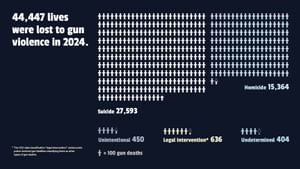
Gun violence can come in many forms. While mass shootings often make up most gun violence news coverage, they represent only 2% of gun deaths. The majority of gun deaths in the U.S. are suicides, followed by homicides. Homicides were the most common type of gun death among children and teens (ages 1–17) nearly 60%,, followed by suicides at 31%.
Source: Johns Hopkins Center for Gun Violence Solutions 2024
8 kids a day are injured or killed as a result of unintentional shootings.
Source: CDC
In 2024, 45% of suicide deaths among children and adolescents involved a firearm.
Source: KFF 2024 Report
Nearly 60% of all gun deaths among children and teens (ages 1-17) were due to homicide.
Source: Johns Hopkins Center for Gun Violence Solutions 2024
Since the Columbine high school massacre in 1999, almost 400,000 students have experienced gun violence at school (Source: The Washington Post). Many American children live in constant fear that gun violence may affect their community, school, someone they love, or themselves.

Youth populations impacted by gun violence
Gun deaths accounted for 85% of all homicides among Black youth ages 1-17. Among Black youth ages 10-17, nearly half 48% of all suicides were by gun.
Source: Johns Hopkins Center for Gun Violence Solutions 2024
The gun homicide rate for Hispanic/Latino youth 1-17 was 3 times higher than that of their white counterparts.
Source: Johns Hopkins Center for Gun Violence Solutions 2022
American Indian and Alaskan Native youth ages 1-17 died from firearms at a rate more than double the national average.
Source: KFF 2024 Report
White youth ages 10-24 years old experience the majority (68%) of those who die by youth gun suicide.
Source: CDC 2023
Gun injuries are preventable
Many people don't realize that gun injuries are the leading cause of death among children and teens. Talking about this—and how we can change it—may inspire others to take action.

Starting a conversation is a great first step. You can also help prevent gun violence by taking the following actions:
- Understand how gun violence affects your community. Whether you are a gun owner or not, take the time to understand the impact that gun violence has had on your community.
Learn about organizations and strategies to help individuals at the highest risk of gun violence, providing support and resources to promote safety and disrupt the cycle of violence. - Know the warning signs. Familiarize yourself with the signs that someone may intend to harm themselves or others. If you see signs that someone may be in crisis, make sure they don’t have access to a gun and help them find support.
- Store firearms securely. If you own guns, always keep them locked, unloaded, and separate from ammunition. If you don't own a gun, talk with others about the importance of secure firearm storage.
Frequently asked questions
Getting involved is as easy as starting a conversation. Talk with others in your community, whether they are parents or caregivers or not and whether they are gun owners or not. Use the conversation guides on this website for help getting started.
You can have these conversations with just about anyone—parents, concerned adults, health care professionals, children, and others in your community, including people in gun violence prevention groups and organizations.
Yes! Our research shows:
79% of Americans rank gun violence as one of their top three concerns.
Source: Ad Council Research Institute Gun Violence Survey, 2024
80% of Americans in households with gun owners agree that practicing safe gun storage would reduce gun violence.
Source: Ad Council Research Institute Gun Violence Survey, 2024
8 in 10 Americans agree productive conversations can help reduce gun injuries.
Source: Ad Council-led survey, 2024
Starting conversations helps others realize how much common ground there is on this topic, so they feel comfortable talking about secure gun storage and other ways to prevent gun violence. You can also discuss how to recognize the signs that someone may be in crisis, and why it's important to take action immediately in these situations. Having these conversations normalizes them, giving more people the information they need to help keep children and teens safe.
Take action to reduce gun injuries
Explore our tools and resources for more ways to protect children and teens from gun injuries.